
Sanakai & Hadohaij Reference
Status: Canon-aligned phoneme and glyph reference
Language: Hadokai Tubatonona / HT
Scope: Sound inventory, typed romanization, hadohaij glyph rendering, sanakai vowels, consonants, ungU, and fixed symbol-to-sound mapping
The Tubatonona Writing System
The Tubatonona call their alphabet hadohaij — the collection of written characters used in their language. Each individual character is a hadohaijkai. Each hadohaijkai represents a distinct sound, which we call a sanakai (unique sound). This reference documents all 28 sanakai used in Hadokai Tubatonona.
Hadokai Tubatonona is written in the hadohaij.
All Romanized forms are representations for accessibility, instruction, and input, not the language itself.
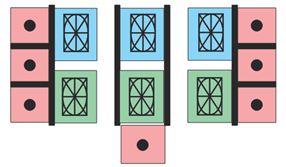
The hadohaij is organized into hadohatiij (syllable sets) — three distinct structural patterns used to write syllables. Every syllable occupies three positions:
- hadohatiSe — the first symbol position (opening consonant, shown in blue)
- hadohatiij — the syllable set structure itself (vowel area, shown in pink)
- hadohatinidok — the last symbol position (closing consonant, shown in green)
The three hadohatiij (syllable sets) are:
- hadohatiijSa — the shield-side (left-facing) syllable set, which holds the vowels a, e, U
- hadohatiijka — the arms-side (right-facing) syllable set, which holds the vowels i, o, I
- hadohatiijkaSa — the center syllable set, which holds the vowel u
Phoneme Naming System
The 28 sanakai are named according to three principles, one for each category of sound.
Consonants are named using the bookend convention: the consonant occupies both the opening and closing positions of a single CVC syllable, with the vowel a as the carrier. The consonant demonstrates itself in both positions, and the name is a complete, legal HT syllable. For example, the consonant b is named bab, the consonant d is named dad, and the consonant k is named kak. This convention applies to every consonant that produces sound — all twenty of them. It reflects the structural completeness valued by the Tubatonona — nothing left undemonstrated.
Vowels are named by their own sound. A vowel needs no structural frame to identify itself — it simply is. The spoken name of each vowel is its pronunciation: a is called ah, e is called eh, i is called ee, and so on. When written in strict CVC form, each vowel appears as =V= (the silent consonant occupying both consonant positions around the vowel), but =V= is the structural representation, not the spoken name.
The silent consonant, ungU, is named by its proper name rather than by the bookend convention. ungU is the one member of the consonant inventory whose phonetic realization in syllable position is silence. The spoken name ungU is audible; it names the consonant and the concept of structural completion. The consonant cannot demonstrate itself in both positions in the way the voiced consonants do, because its bookend form (=a=) would be indistinguishable from the strict CVC representation of the vowel a. ungU receives a unique name because it is unique: it represents the structural presence of no-sound, not the absence of structure.
Romanization Conventions
Hadokai Tubatonona romanization uses two modes: casual and strict.
Casual mode omits ungU (the silent consonant) from romanized text. When a syllable’s opening or closing consonant position carries no sound, it is simply left unmarked. For example, the word pronounced “da” is written da in casual mode, even though the syllabic structure includes ungU in the closing position.
Strict mode explicitly marks ungU with the equals sign (=). The same word is written da= in strict mode, showing the complete CVC structure. Strict mode is used when teaching the language, analyzing syllable structure, or preparing text for the HT font renderer.
Input Conventions
Some characters have special or easily misread input conventions. In HT typed romanization, each listed character has one fixed sound and must be read as canonical HT, not as English spelling:
|
HT Glyph |
Romanized Character |
IPA Sound |
IPA “as in” |
|||
|---|---|---|---|---|---|---|
|
c |
c |
/ʧ/ |
“check” or “church” |
|||
|
j |
j |
/dʒ/ |
“judge” or “gel” |
|||
|
S |
S |
/ʃ/ |
“shoe” or “fish” |
|||
|
w |
w |
/ʒ/ |
the “s” in “vision” |
|||
|
y |
y |
/j/ |
“yes” or “yolk” |
|||
|
I |
I |
/ɪ/ |
“bit” or “kit” |
|||
|
U |
U |
/ʌ/ |
“cut” or “hut” |
|||
|
e |
e |
/ɛ/ |
as in “pet” or “jet” |
|||
|
= |
= |
/∅/ |
ungU, the silent consonant, used in strict mode only |
Why this matters:
- If you see y in a keyboard transcription, it represents the /j/ sound (as in “yes”), not the /i/ vowel.
- If you see w in a keyboard transcription, it represents the /ʒ/ sound (as in “vision”), not the /w/ sound (as in “water”).
- Uppercase letters (I, U, S) represent distinct sounds and must be typed exactly as shown for the font to render correctly.
These conventions make the romanization more intuitive for English speakers while maintaining phonological precision.
All phoneme entries below use strict mode notation to show the complete syllabic structure.
Phoneme & Glyph Reference
ro=pensam =alda=gi=ro=da==ir =aw
“In Balance, Brilliance”
28 entries
Consonants 21 entries 21 characters · keyboard input maps to Latin equivalents
Vowels 7 entries 7 characters · U and I are uppercase to distinguish from u and i
Phonotactics and Sounds
Phonotactics are the rules governing which sound combinations are permitted in a language. Hadokai Tubatonona enforces strict phonotactic constraints at the syllable level:
Within a syllable:
- Exactly one vowel — never more, never less.
- No consonant clusters — no two consonants may appear consecutively within a single syllable.
- No vowel clusters — no two vowels may appear consecutively within a single syllable.
Across syllable boundaries:
- Consecutive vowels are permitted — the syllable boundary separates them structurally (e.g., a.e, tu.i).
- Consecutive consonants are permitted — the syllable boundary separates them structurally (e.g., al.da, bak.na).
These constraints ensure that every syllable conforms to the CVC structure and that syllable boundaries remain clear and unambiguous in both written and spoken forms.
Valid examples:
- a.e — two syllables, vowels separated by boundary
- al.da — two syllables, consonants l and d separated by boundary
- bak.na — two syllables, consonants k and n separated by boundary
Invalid within a syllable:
- *ae — two vowels in one syllable (not permitted)
- *bka — two consonants in one syllable (not permitted)
The Silent Consonant: ungU
The silent consonant, represented in keyboard input as the equals sign (=), occupies a unique position in Hadokai Tubatonona phonology and script. The = symbol is not punctuation, an operator, or an empty placeholder. It is the strict romanization marker for a full member of the consonant inventory. The spoken name ungU is audible. The consonant’s phonetic realization in syllable position is silence when no voiced consonant occupies that position.
ungU represents the structural presence of no-sound. In Hadokai Tubatonona, every syllable must occupy three positions: opening consonant, vowel, closing consonant. When a consonant position carries no voiced sound, ungU fills that position. It is not an absence — it is an occupation. The Tubatonona do not leave structure incomplete. What carries no voice still carries presence.
This concept is distinct from environmental silence — the quietness of a still room or an unspoken moment. ungU is not the world being quiet. It is a specific structural position being filled by a consonant whose voicing is silence. The difference is architectural: environmental silence is a state that happens; ungU is a structural act of completion.
Syllable Structure
When Hadokai Tubatonona is transcribed into English or other Earth-based languages, the silent consonants (ungU) are typically omitted, as shown in the Casual Latin, just as silent placeholder consonants are ignored when transcribing Hangeul into Latin script. This creates four surface forms in casual romanization:
- V — both consonants silent (e.g., =a= becomes a)
- CV — trailing consonant silent (e.g., ba= becomes ba)
- VC — leading consonant silent (e.g., =ak becomes ak)
- CVC — both consonants voiced (e.g., bak remains bak)
|
HT Formal (CVC) |
Example |
HT Example (correct) |
Casual Latin |
Latin Example |
HT Example |
|---|---|---|---|---|---|
|
CVC |
=al |
=al |
VC |
al |
al |
|
CVC |
lo= |
lo= |
CV |
lo |
lo |
|
CVC |
mak |
mak |
CVC |
mak |
mak |
|
CVC |
=a= |
=a= |
V |
a |
a |
Stress
In spoken HT, stress may fall on any syllable within a word to indicate personal emphasis or expressive focus. This is a feature of casual spoken behavior, not a grammatical mechanism. In formal or strict usage, all syllables carry equal weight, and meaning is determined by morphological structure and word order rather than by emphasis.
Shifting stress in casual speech can highlight different aspects of a compound word without changing its structural meaning. For example, in the word joalca (the blue rock), a speaker might stress jo to draw attention to the rock itself, or stress al to emphasize the water-nature of the color. The meaning of the word does not change — the speaker’s focus does.