
Hadohatiij Reference
Status: Canon-aligned script structure reference
Language: Hadokai Tubatonona / HT
Scope: Strict CVC syllable structure, hadohatiij forms, glyph construction, ungU placement, casual-to-strict structural completion, and syllable-boundary behavior
ro=pensam =alda=gi=ro=da==ir =aw
“In Balance, Brilliance”
The Hadokai Tubatonona language is written in the hadohaij — the complete system of written forms used to express all sanakai. Each written unit is constructed according to fixed structural principles that define how sound, position, and form interact.
All romanized forms presented here exist only as accessible representations of the hadohaij. The structure described on this page belongs to the script itself. Romanization reflects that structure — it does not define it.
The Three-Position Structure
Every syllable in Hadokai Tubatonona occupies exactly three positions:
- hadohatiSe — the opening consonant position
- hadohatiij — the vowel structure (syllable core)
- hadohatinidok — the closing consonant position
The structure is strictly CVC. No syllable is partial. No position is unfilled. Because each syllable carries exactly one vowel, the count of vowels in any word is identical to the count of syllables.
When no pronounced consonant occupies a position, ungU fills it. ungU is not an absence — it is the structural presence of no-sound. The language does not permit empty structure.
The spoken name ungU is audible. The consonant’s phonetic realization in syllable position is silence when no voiced consonant occupies that position. The equals sign (=) is the typed strict romanization marker for the consonant position.
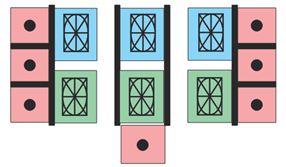
The three hadohatiij: hadohatiijkaSa (center), hadohatiijSa (shield-side), hadohatiijka (arms-side).
Color coding: blue = hadohatiSe, pink = hadohatiij vowel area, green = hadohatinidok
The Three Syllable Sets (Hadohatiij)
The hadohaij organizes all syllables into three structural sets. Each set defines both the vowels it contains and the geometric form used to write them.
hadohatiijSa — Shield-Side (Left-Facing)
Sanakai:
a e U
The structure forms a 2×3 rectangle. The left column is subdivided into three rows by horizontal strokes running from the outer left edge inward to the central divider. Each cell holds one sanakai vowel, marked by the placement of a dot within the cell:
- Top cell — a
- Middle cell — e
- Bottom cell — U
The right column is divided into two rows:
- Upper — hadohatiSe (opening consonant)
- Lower — hadohatinidok (closing consonant)
The orientation — vowels left, consonants right — gives this set its name. Its form presents a stable, forward-facing edge.
Example — the syllable les:
les
Built on hadohatiijSa. The consonant l occupies the hadohatiSe, the dot marks the middle cell for e, and the consonant s occupies the hadohatinidok.
hadohatiijka — Arms-Side (Right-Facing)
Sanakai:
i o I
This set mirrors hadohatiijSa. The structure is identical, with vowel cells on the right and consonant positions on the left — strokes running from the outer right edge inward to the divider.
- Top cell — i
- Middle cell — o
- Bottom cell — I
Consonant rows:
- Upper — hadohatiSe (opening consonant)
- Lower — hadohatinidok (closing consonant)
The mirrored structure creates balance across the system. Opposing forms share identical internal logic but face in opposite directions.
Example — the syllable dok:
dok
Built on hadohatiijka. The consonant d occupies the hadohatiSe, the dot marks the middle cell for o, and the consonant k occupies the hadohatinidok.
hadohatiijkaSa — Center (Vertical)
Sanakai:
u
A single column flanked on each side by a vertical line. The consonant area is divided into two rows:
- Upper — hadohatiSe (opening consonant)
- Lower — hadohatinidok (closing consonant)
Beneath the consonant rows, a third row holds the vowel dot for u. This vertical layout aligns all three positions on a single axis.
This set stands apart geometrically — a column rather than a rectangle — while remaining fully integrated within the three-position model. It carries one sanakai vowel, and its distinct form makes it immediately recognizable.
Example — the syllable put:
put
Built on hadohatiijkaSa. The consonant p occupies the hadohatiSe, the dot marks u, and the consonant t occupies the hadohatinidok.
Structural Completion and ungU
In every syllable, all three positions must be present and filled.
When a consonant position carries no pronounced sound, ungU occupies that position. In strict romanization, ungU is written as the equals sign: =. In casual romanization, it is omitted.
The omitted casual mark does not remove the consonant from the structure. It only leaves the silent consonant unmarked on the surface. The underlying position remains occupied.
|
hadoha |
Strict |
Casual |
Structure |
|---|---|---|---|
|
=a= |
=a= |
a |
Both consonant positions filled by ungU |
|
ba= |
ba= |
ba |
Closing position filled by ungU |
|
=ak |
=ak |
ak |
Opening position filled by ungU |
|
bak |
bak |
bak |
Both consonants pronounced |
The casual form is a representation convenience. The underlying structure is always complete.
Structural completion shows whether a form can fit HT syllable structure. It does not by itself define a word or authorize meaning. Lexical definition, canonical confirmation, or deconstruction doctrine governs meaning and canon status.
Word Structure
Words are formed by placing complete syllable blocks side by side. Each block is one of the three hadohatiij, filled with its consonant glyphs and vowel dot.
Example — the word david:
dav=id
Two hadohatiij. The first (dav) is built on hadohatiijSa — d opens, a is the vowel, v closes. The second (=id) is built on hadohatiijka — ungU fills the opening position, i is the vowel, d closes. In strict romanization: dav=id.
Sentence Structure
Sentences are constructed as ordered sequences of complete syllable blocks. Structure is maintained consistently across word boundaries.
Example:
ha=do=ka==i= tu=ba=to=no=na= tu= ba=la=na= =aw
Casual romanization: hadokai tubatonona tu balana aw
Strict romanization: ha=do=ka==i= tu=ba=to=no=na= tu= ba=la=na= =aw
The sentence expresses: “I speak Tubatonona Language.”
In the strict form, every consonant position is visibly occupied — pronounced consonants and ungU alike. The casual form omits ungU for readability, but the structure beneath remains the same.
Phonotactic Integrity
Hadokai Tubatonona enforces strict structural rules:
Within a syllable:
- Exactly one vowel
- No consonant clusters
- No vowel clusters
Across syllable boundaries:
- Consecutive consonants are permitted — the boundary separates them (e.g., al.da, bak.na)
- Consecutive vowel letters may appear in casual romanization across syllable boundaries; in strict romanization, ungU fills the closing position of the first syllable and the opening position of the next. (e.g., a.e, tu.i)
These constraints preserve the clarity of every syllable in the hadohaij; casual romanization may omit ungU and therefore may require lexicon-supported resolution.
On Representation
Romanized forms on this page are presented in casual notation for readability. Strict notation may be used when structural clarity is required.
The hadohaij remains the primary form of the language. All structural principles described here originate in the script itself.
Closing Principle
Hadokai Tubatonona does not permit incomplete form.
Every sound occupies a position. Every position is filled. What carries no voice still carries presence.