Tubatonona are a lost ancient race of mystical people and were tasked with the creation of objects imbued with mystical influences. Their ability to work with materials was extraordinary but most, if not all of that ability, was lost when the last of the Tubatonona were exterminated.
https://www.kreativekorp.com/clcr/register.php
Balance (The Dance)
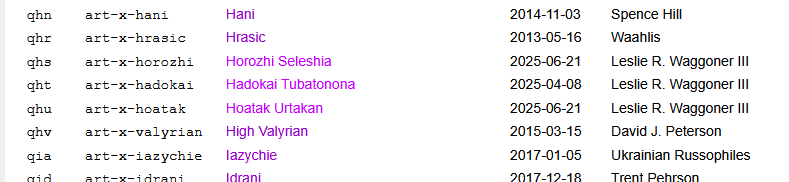
Language Name: Hadokai Tubatonona (The Unique Language of the Tubatonona)
Percentage Complete: 70%
Nature: Mediation, adaptability, coexistence of opposites.
Philosophy:
“From the void emerged Chaos, and as Chaos was wont, in the instant of creation it took every form until it birthed Order. Order emerged whole and complete, the equal of Chaos, though it was its complete opposite. The eddies and flows between Chaos and Order built and created, killed and destroyed the cosmic universes infinitely as the scales weighed to one side or the other. As one side would burgeon, extend and increase, bloated in its expansion, the other would consolidate, strengthen and reinforce. And thus, one was unable to ever triumph over the other, and though each strove to obtain this triumph, they knew to do so would be the return to the void, as choas and order cannot exist, one without the other. And so they understood their inability to abide the other was not acceptable. In understanding the inability for them to self-regulate, Chaos and Order created Balance and gave Balance equal standing to Chaos and Order.”
Cultural Traits:
The Balance (Dance) chose a middle-ground between Chaos and Order.
Those who follow Balance seek equilibrium in all things rather than dominance.
Writing System:
Aesthetic:
Syllabic, but strictly one symbol per sound (no phonetic variation based on position).
Blends structured formality with fluid grace.
There are no double consonants, nor any double vowels within a single syllabic structure.
Syllabic Structure:
Every syllable in Hadokai Tubatonona follows a strict CVC format — one opening consonant, one vowel, one closing consonant — without exception. Where English would leave a consonant position unfilled, HT does not. Any consonant position that carries no sound is occupied by a null consonant: a dedicated character that is written and visible but voiced as silence. The null consonant is not an absence — it is a full member of the script, ensuring every syllable block is always complete.
When typing in Latin characters, the null consonant is entered as a hyphen ( – ), which the system automatically converts to the null glyph in the HT font. The null glyph is visually similar to an equals sign but is a distinct character purpose-built for HT.
For example, the word dae in Latin typing becomes da- -e- — the closing position of da and both consonant positions of e are each filled with a null, producing two fully formed CVC syllable blocks rather than one open and one vowel-only syllable.
Script Direction: Left-to-right, top-to-bottom, mirroring the Universal “Common” script.
Grammar: Object-Subject-Verb (OSV) – A compromise between the others.
Phonetics:
Uses both sharp and vibratory consonants for balance (T, D, F, V, P, B).
More fluid vowel connections to blend words harmoniously.
Engraved ceremonial pillars:
“In Balance, Brilliance.
In every motion, there is balance; in every stillness, a new dance.
Without and within is the only way forward.”
Lexicon
Numeric system:
Hadokai Tubatonona Mathematics
Grammar Structures
Hadokai Tubatanona Grammar Structures